Delve into the Research
Scroll down to visit each section.
Restoring the health of sugar bushes with firewood ash
Before FOTMW could broadly recommend using residential firewood ashes to fix “ecological osteoporosis”, the calcium (Ca) loss in our forests that was a legacy of acid rain, we needed to prove it would work. Hence, we worked with students (Shelby Conquer and Batool Syeda) in Dr. Shaun Watmough’s group at Trent University. In this paper they summarize two years of post-ash treatment data gathered in the three sugar bushes we treated with residential wood ash. Their results were striking and consistent across the sugar bushes. The ash additions worked. They were a good source of calcium and other essential nutrients and amending soils with 4 tonnes of ash/ha improved soil chemistry, and the nutritional status of seedling and mature maple without producing a metal pollution problem that had been a concern to regulators. Local waste and environmental manages can now confidently consider developing ash recycling programs to foster community engagement in what is a more circular economy.
SCIENTIFIC PAPER
SCIENTIFIC PAPER
Non-industrial wood ash has the chemistry to be accepted as a forest soil amendment
Before FOTMW could broadly recommend using residential firewood ashes to fix “ecological osteoporosis, we needed to prove it had the needed chemistry, both enough of the key nutrients, especially calcium, that are currently limiting sugar maple growth, and low enough metals levels to not present a concern to forest and water managers. Hence Batool Syeda in Dr. Shaun Watmough’s group at Trent University, measured the chemistry of over 100 individual and 3 non-industrial wood ash composite samples (mainly residential fire wood ash), collected by Muskoka residents. The analyses proved that Muskoka residential wood ash would be acceptable as a forest soil amendment anywhere in Canada. Nutrients levels were similar to those in industrial wood ash, while trace contaminant levels were actually lower. The study proved that Muskoka’s residential wood ash could be recommended as a forest soil amendment to redress the damage done by decades of acid rain.
Does sugar maple foliage or sap flow and sweetness change with additions of residential firewood ash?
Maple sap production is a signature industry in the mixed hardwood forests of eastern Canada, including Muskoka, but trees in sugar bushes are currently not as healthy or productive as they could be. Why? Because decades of acid deposition stripped nutrients, especially calcium, from the soil in sugar bushes. While we have shown that residential firewood ashes restore soil chemistry and foliar nutrition without leading to metal contamination of trees, we didn’t know what would happen to maple sap production rates, sweetness or chemistry. To test this, FOTMW staff and Trent U students tapped a dozen sugar maple on ash-treated and control plots at Camp Big Canoe for two spring sap flow seasons. The results were worked up by MSc student Shelby Conquer, and they were positive. Sap volume increased one year after ash addition, with no reduction in sweetness. This benefit lasted only the first year however, and there were no other consistent differences in sap chemistry between treated and control plots. This suggests that residential firewood ash is a viable nutrient supplement that can enhance soil fertility in likely tree growth and health in sugar bushes with no detrimental impacts on sap sweetness.
SCIENTIFIC PAPER
SCIENTIFIC PAPER
A review of the use of industrial wood ash as a forest soil amendment
While the focus of ASHMuskoka is on non-industrial, mainly residential wood ash, there’s roughly 10 times as much firewood ash produced by industry then by home heating. Kathy Corcoran reviewed what is known about the current use of this industrial ash as a forest soil amendment around the world. She noted that while vast acreages of forest currently suffer from calcium deficiency, a legacy of acid rain, and wood ash is high in calcium, the vast majority of industrial wood ash is landfilled in North America, despite benefits demonstrated in Scandinavian managed forests. This review noted that industrial wood ash is routinely classified as a potentially hazardous waste, and this limits its use in what could be a circular forest economy in Canada. This is despite the success of recycling wood ash demonstrated by the Domtar Windsor Mill in Quebec. Corcoran provides a detail overview of issues related to site planning, preparing the ash, storing and spreading the ash. She recommends that regulators need to clarify the “waste” paradigm as it pertains to wood ash, to revisit the regulatory hurdles to ash use, and provide incentives to improve the use and quality of the ash. This review is one of the largest such reviews done in Canada, and should be shared with forest managers and regulators across the country.
Engaging community members to understand the benefits of wood ash additions in Muskoka forests
While FOTMW involved academic researchers and their students in filling knowledge gaps about the impacts of wood ash additions to sugar bushes, we also engaged the community. FOTMW staff prepared homogenized ash doses, enough to treat one tree, to share with the community along with training materials and videos for treating and trees and collecting ancillary data. This report by Paroschy and Sinclair documents the training methods and materials and overall approach to involving the community in actual experiments to test if ash additions would benefit individual trees on private residential properties. The success of this program indicated we could confidently share our ash with members of the public for their use in restoring the health of their own trees without our overriding supervision.
SCIENTIFIC PAPER
SCIENTIFIC PAPER
Might wood ash additions alter forest evapotranspiration rates?
Calcium addition experiments conducted in the NE USA indicated that forest transpiration rates are reduced when the forests are calcium-limited increasing stream flow, and restoring soil calcium levels can restore normal, i.e. higher, rates of transpiration. Because this may have implications for the severity of spring flooding, FOTMW contracted Zygoptera Environmental Consulting to review methods of measuring forest evapotranspiration, and to speculate on whether ash additions might increase transpiration rates. The report summarized methods that could be used to address the question, argued it was worth pursuing, but did not speculate on what hydrological changes would follow ash treatment of watershed. Given the increasing apparent frequency of severe spring floods in Muskoka, the possibility of reducing this severity by restoring forest health and transpiration rates is worth investigating.
Might soil acidification and calcium loss damage terrestrial crustaceans and molluscs?
while the focus of ASHMuskoka was on trees, there are calcium-rich fauna in our forests too, especially molluscs (land snails) and crustaceans (isopods) and birds. Hence, FOTMW decided to review what is known about damage to Ca-rich forest biota by soil acidification and de-calcification. The review found remarkably little work has been done on the impacts of falling Ca levels on these fauna, with no studies in Canada! Nonetheless, the review did find that snails and isopods should respond positively to increased calcium availability. Hence it would be worth quantifying the benefits of wood ash additions on the calcium-rich fauna of local forests.
SCIENTIFIC PAPER
SCIENTIFIC PAPER
Wood ash as a solution to calcium decline in Muskoka forests
Acid rain stripped calcium from Canadian forests limiting their health and growth. This review asks whether using wood ash as a soil amendment could fix the problem, and, after examination of the scientific literature on the topic concludes that it could very well be a good solution.
What communities need to know to set up their own ash-recycling programs
By 2021, FOTMW had spent 2 years running volunteer-run monthly drives to collect firewood ash at the local municipal waster transfer station. We made lots of mistakes and learned a lot. To help other communities learn from us, we contracted Kathy Corcoran to prepare a citizen-facing operational guide on everything we had learned “from soup to nuts”, or in this case from assessing the need, learning the regulatory issues, developing community partnerships, marketing and branding, attracting and retaining volunteers, equipping and running the actual drives, storing the collected ash, dispersing it, measuring the benefits and everything in between.
SCIENTIFIC PAPER
SCIENTIFIC PAPER
Why our community should be recycling wood ash to the forest
Azan, S. 2018. Your guide to HATSEO Wood Ash recycling in Muskoka. 10 pp.
This short, photo-laden guide was produced very much with the community in mind. It briefly explains the calcium decline problem in our lakes and forests, and how firewood ash recycling can divert waste from landfills, help mitigate climate change, and increase forest production. It provides a first estimate of how much residential firewood ash is produced in Muskoka, what the risks and benefits of using it might be and it proposed moving forward with a large scale wood ash recycling effort.
Can residential wood ash be safely used to treat the calcium decline problem in our forests and lakes?
Knowing that there was enough firewood ash produced in Muskoka to consider launching a wood ash recycling project, we next need to know the chemistry of the ash, particularly its calcium levels and metal contaminant levels, how soluble the various constituents are in water, and any risks of short-term toxicity of materials dissolving from the ash into soil or other receiving waters. This report provides answers to those three questions. We learned that the calcium in the ash was a slow release fertilizer, a good thing, the phosphorus was quite insoluble, also a good thing, while the potassium dissolved very quickly and might pose a local toxicity problem if doses were large and localized. We also learned that metal concentrations should not pose an issue to regulators. This work convinced us that working towards a large scale wood ash recycling program made sense.
SCIENTIFIC PAPER
SCIENTIFIC PAPER
What dooes the Muskoka wood heat community think about an ash recycling program?
This report was one of FOTMW’s early considerations of whether or not a large-scale ash recycling program was worth pursuing. We received feedback from 53 Muskoka residents who told us what tree species, they used for firewood, what parts of the trees they burnt, what they currently did with their ashes, how much ash they estimated they produced. Importantly, most recipients told us they would be willing to participate in a wood ash recycling program – good news. With the survey results, local population information and Statistics Canada data on numbers of households that heat with wood, we estimated over 300 tonnes of wood ash are produced in Muskoka each year – enough to justify setting up a wood ash recycling project.
Can residential wood ash be safely used to treat the calcium decline problem in our forests and lakes?
Knowing that there was enough firewood ash produced in Muskoka to consider launching a wood ash recycling project, we next need to know the chemistry of the ash, particularly its calcium levels and metal contaminant levels, how soluble the various constituents are in water, and any risks of short-term toxicity of materials dissolving from the ash into soil or other receiving waters. This report provides answers to those three questions. We learned that the calcium in the ash was a slow release fertilizer, a good thing, the phosphorus was quite insoluble, also a good thing, while the potassium dissolved very quickly and might pose a local toxicity problem if doses were large and localized. We also learned that metal concentrations should not pose an issue to regulators. This work convinced us that working towards a large scale wood ash recycling program made sense.
SCIENTIFIC PAPER
REPORT
Citizen scientists localize road salt pollution in Muskoka
Hutchinson, N. 2025. Citizen science investigations of road salt pollution in Muskoka: 2022-2024.
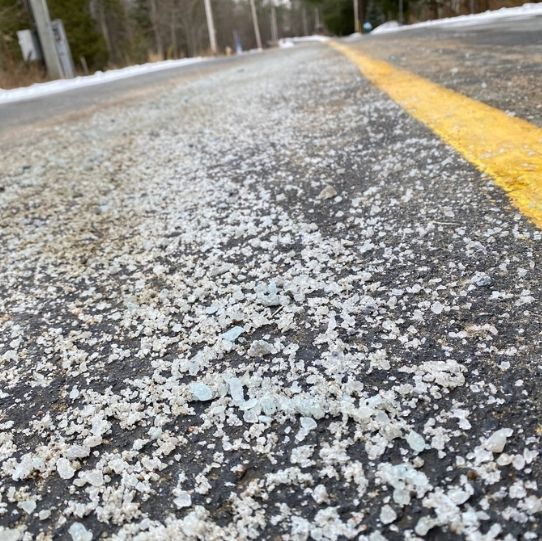
The FOTMW has 4 criteria to select environmental issues to address. The issues must be widespread, severe, currently mismanaged, and amenable to improvement if professionals engage with the community, i.e. if professional scientists train and then work with citizen or community scientists. In this report, Dr. Neil Hutchinson from the FOTMW identified the land use types in Muskoka most responsible for large inputs of chloride, in the form of road salt to the watershed. On 600 occasions volunteers measured water conductivity, from which chloride levels can be accurately estimated, at 27 Muskoka sites. While most sites had little chloride elevation, and few were clear and enormous sources of chloride-contaminated runoff. Sites of these types should be a focus of remedial efforts to reduce excess salt runoff. It was community scientists, working as volunteers, that helped FOTMW professionals identify land use types most in need of attention to reduce the road salt threat in Muskoka’s soft waters.
The Canadian water quality guideline for chloride does not protect Muskoka lakes from road salt pollution
This paper provided three lines of evidence that the current Canadian water quality guideline for Chloride is not sufficiently protective for soft-water Muskoka lakes. First, six species of the water flea Daphnia suffered damage in lab bioassays at Cl levels, of 5 to 40 mg/L well below the current guideline of 120 mg/L. Secondly, zooplankton remains in a sediment profile indicated large community changes when road salting began, and thirdly, 22% of recreational lakes in Ontario currently have Cl levels high enough to damage the animal plankton that keep algae in our lakes under control. This research suggests that we need a chloride standard that will protect biota in soft water lakes, and that every effort should be made to reduce the excessive use of road salt as a de-icer. This paper underpinned the development of our SALTYMuskoka project.
SCIENTIFIC
PAPER
TECHNICAL REPORT
Is there a road salt threat to Muskoka Lakes?
This FOTMW report answered 10 questions whose answers implied that road salt currently does threaten the health of many Muskoka lakes, including our most iconic recreational lakes.
TVO The Agenda featuring SALTYMuskoka
SALTY Muskoka
SCIENTIFIC PAPER
A lake management framework for global application: monitoring, restoring and protecting lakes through community engagement
Despite decades of management and regulation, global freshwater resources remain imperiled. Management has had mixed success in restoring degraded lakes and has few mechanisms for stopping the decline of high-quality systems. Too often, lake managers play catch-up by addressing stressors only after damage occurs or has become entrenched, or make decisions without acquiring sufficient information about how a lake might respond to proposed management actions. As a tool to address these management challenges, we propose the MoReCo (Monitoring, Restoring/Protecting, Community Engagement) lake management framework. The framework centers around community engagement, and we outline engagement mechanisms in the context of lake management. The framework includes 2 loops: a monitoring loop to detect emerging stressors, and a restoring/protecting loop to address stressors that are causing or may cause lake degradation. The MoReCo framework builds on the strengths of existing natural resource management frameworks and was developed to address the unique challenges associated with lake management and protection, as well as those resulting from climate change. Specifically, it can address multiple stressors concurrently, which makes it simultaneously suitable for ameliorating stressors while also protecting lake ecosystems. The MoReCo framework is an interactive and multidirectional process in which management occurs even when no stressor is apparent, and it incorporates explicit benchmarks for evaluating management actions and determining whether additional measures should be taken. This novel lake management framework is suitable to address any stressors that may threaten a lake ecosystem, and we present it here as a resource for those who manage freshwater resources.
Daphnia as sentinel species for environmental health protection: a perspective on biomonitoring and bioremediation of chemical pollution.
Despite available technology and the knowledge that chemical pollution damages human and ecosystem health, chemical pollution remains rampant, ineffectively monitored, rarely prevented, and only occasionally mitigated. We present a framework that helps address current major challenges in the monitoring and assessment of chemical pollution by broadening the use of the sentinel species Daphnia as a diagnostic agent of water pollution. And where prevention has failed, we propose the application of Daphnia as a bioremediation agent to help reduce hazards from chemical mixtures in the environment. By applying “omics” technologies to Daphnia exposed to real-world ambient chemical mixtures, we show improvements at detecting bioactive components of chemical mixtures, determining the potential effects of untested chemicals within mixtures, and identifying targets of toxicity. We also show that using Daphnia strains that naturally adapted to chemical pollution as removal agents of ambient chemical mixtures can sustainably improve environmental health protection. Expanding the use of Daphnia beyond its current applications in regulatory toxicology has the potential to improve both the assessment and the remediation of environmental pollution.
SCIENTIFIC PAPER
REPORT
Interim report of the Muskoka Watershed Advisory Group: Advice and recommendations to address priority environmental issues in the Muskoka River Watershed
The Muskoka Watershed Advisory Group Interim Report provides strategic advice to the Ontario Ministry of the Environment, Conservation and Parks to support the Muskoka Watershed Initiative (MWI), launched in 2018 to protect the ecological integrity of the Muskoka River Watershed while sustaining regional economic activity. The Advisory Group, consisting of nine community-connected volunteers, conducted extensive engagement with more than 60 organizations and stakeholders, including municipalities, Indigenous representatives, local associations, and residents. Based on this input, the report identifies priority environmental challenges such as increased flooding and erosion, declining water quality, biodiversity loss, and habitat fragmentation, with climate change and land-use pressures acting as key drivers.
The report’s central recommendation is adoption of an Integrated Watershed Management (IWM) framework to guide long-term decision-making. IWM emphasizes collaboration across jurisdictions, evidence-based policy, and coordinated action among provincial, municipal, Indigenous, and community partners. To support implementation, the Advisory Group proposes the creation of a Community Round Table, technical task forces, and targeted short-term projects addressing flood mitigation and data gaps. Overall, the report advocates for a proactive, collaborative approach to enhance resilience and sustainability across the Muskoka River Watershed.
WEBINAR
How Lakes Work
Link and title
Description to come soon!
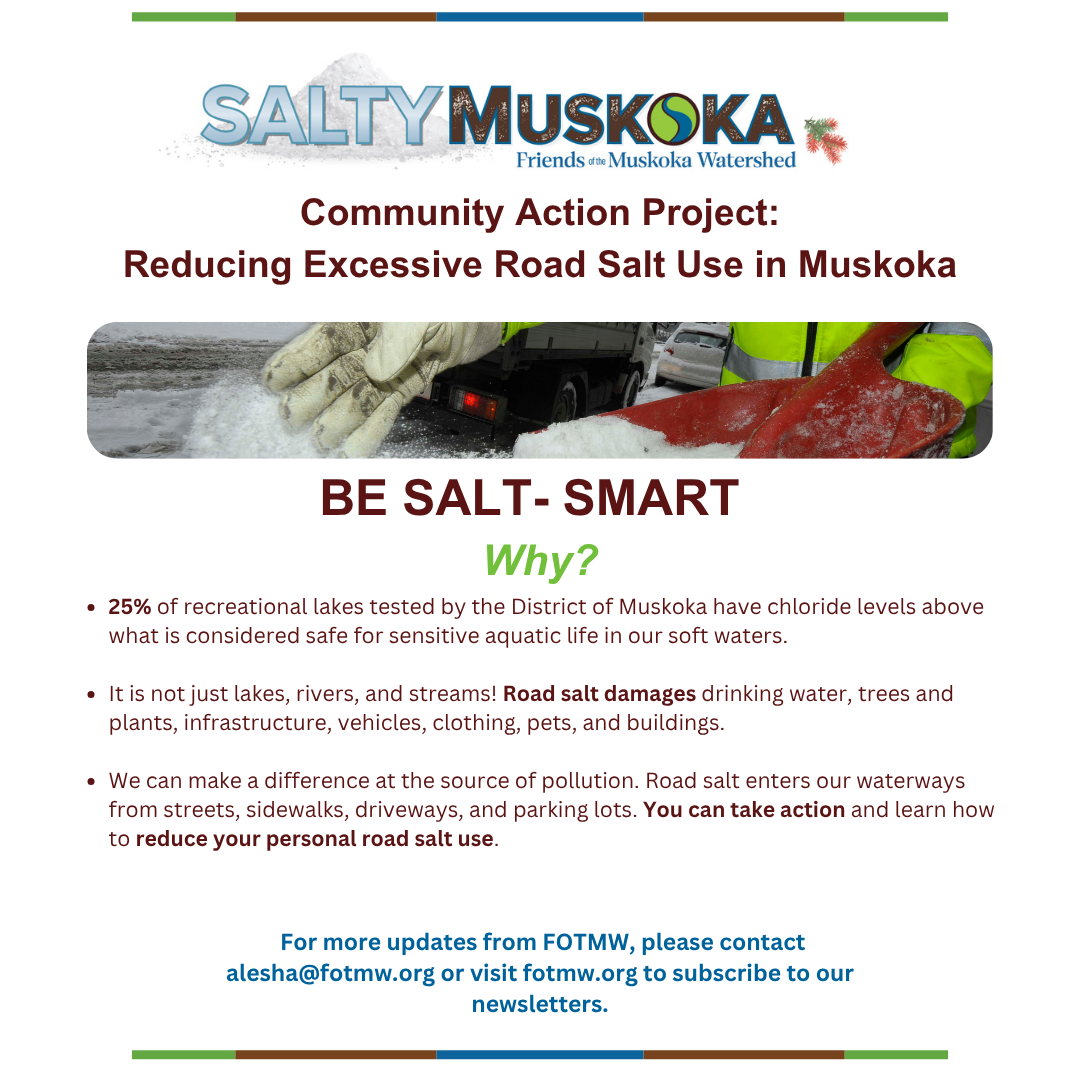
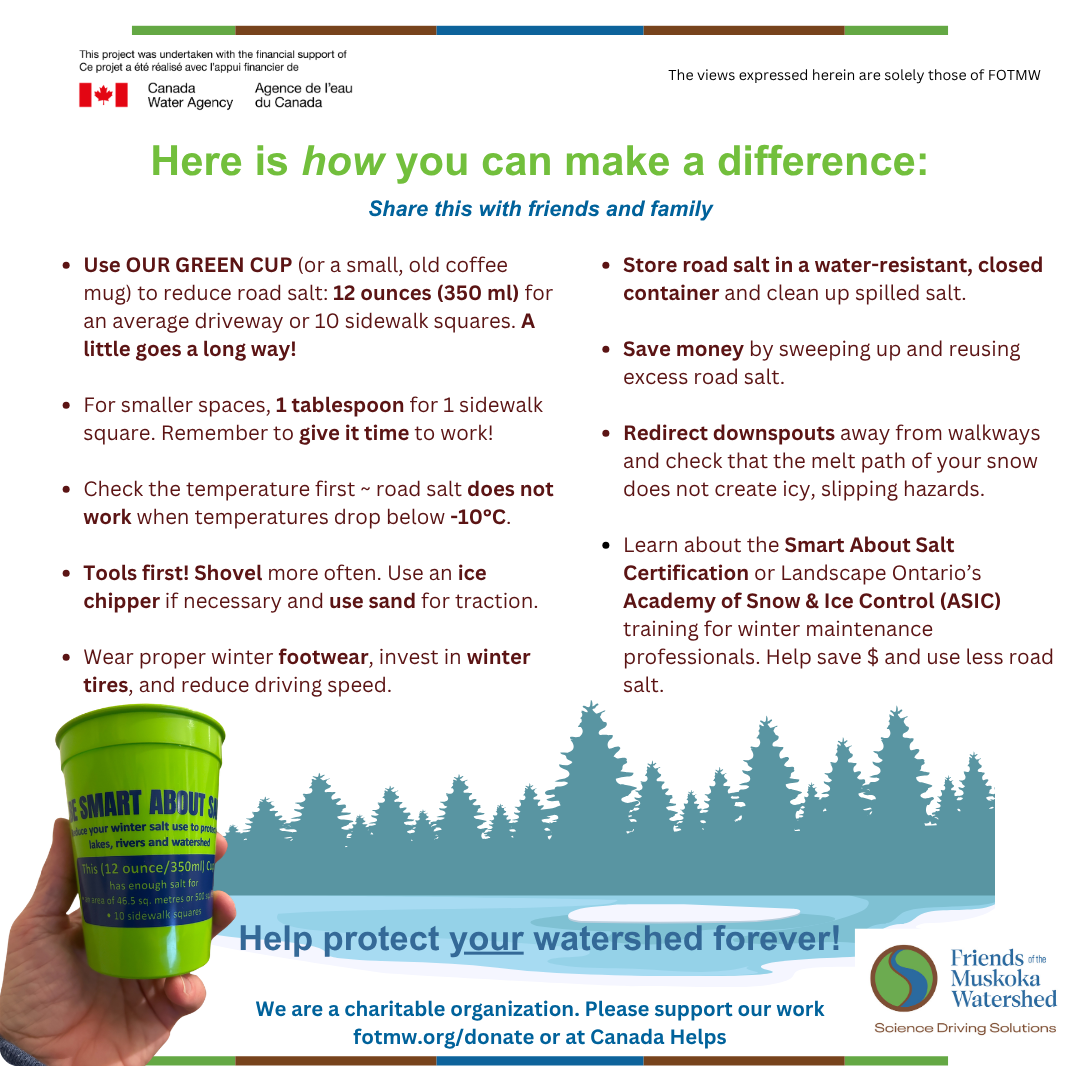
Do you want to do your part to use less road salt and protect the environment while saving money? Read our SALTYMuskoka tips and learn how to reduce your excessive road salt usage. Download the SALTYMuskoka tips and share them with others!
Download SALTYMuskoka Tips printable PDF
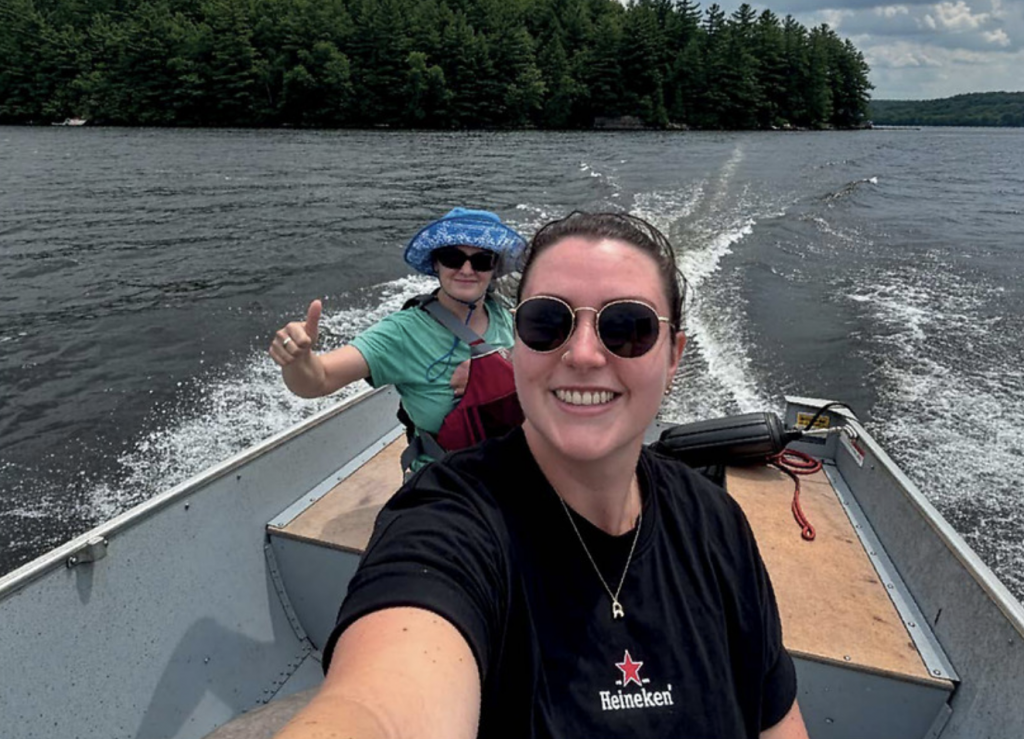
Fighting salt with science: community scientists make a difference.
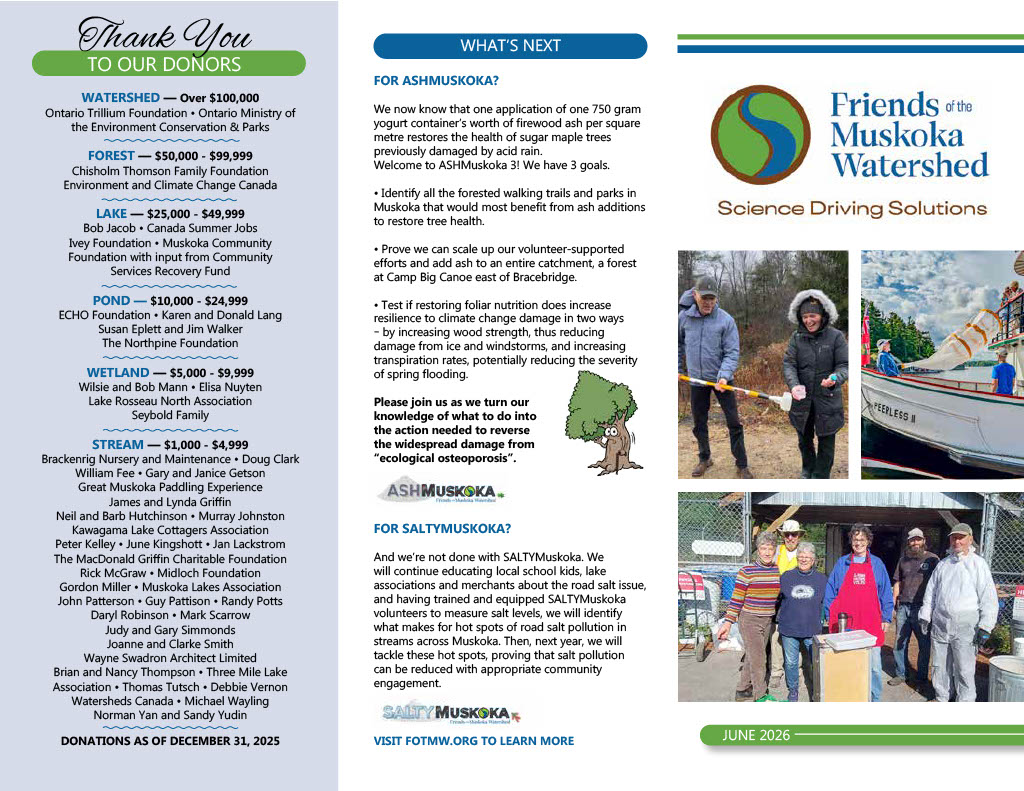
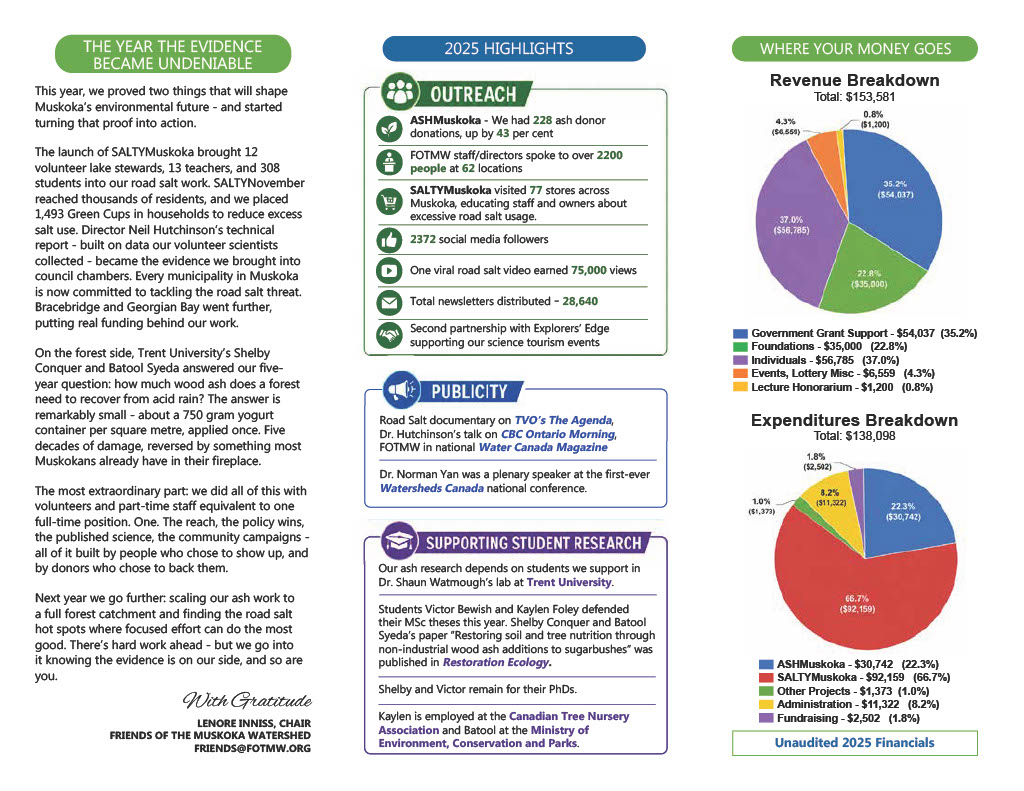
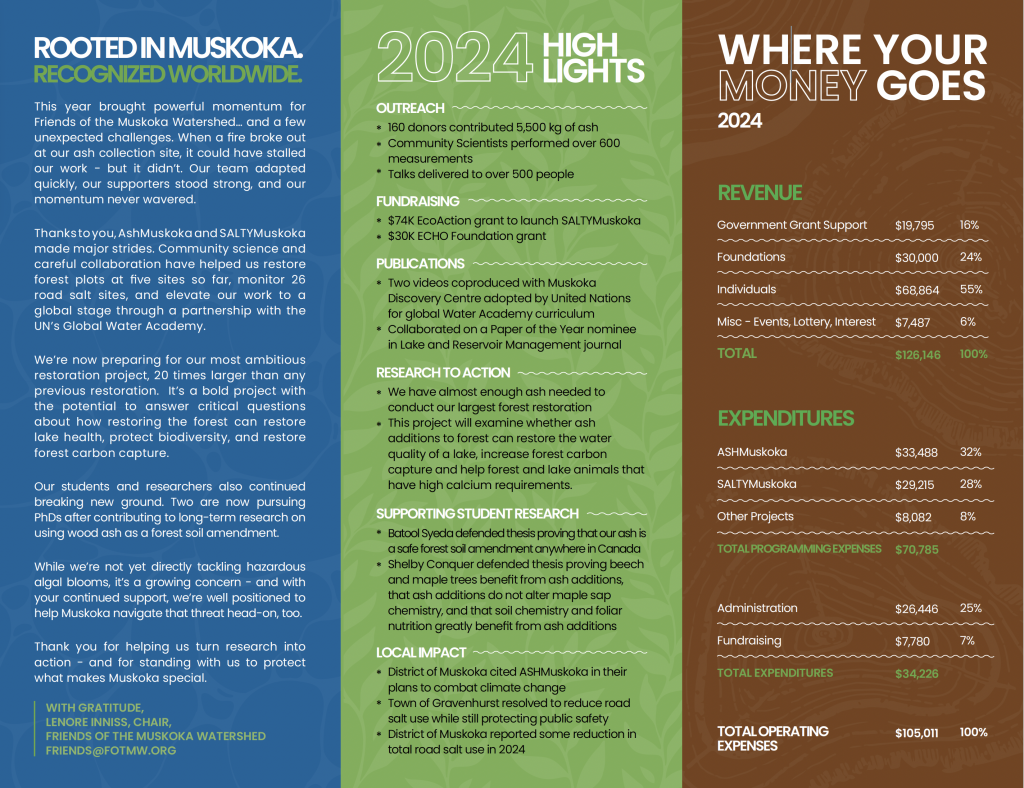
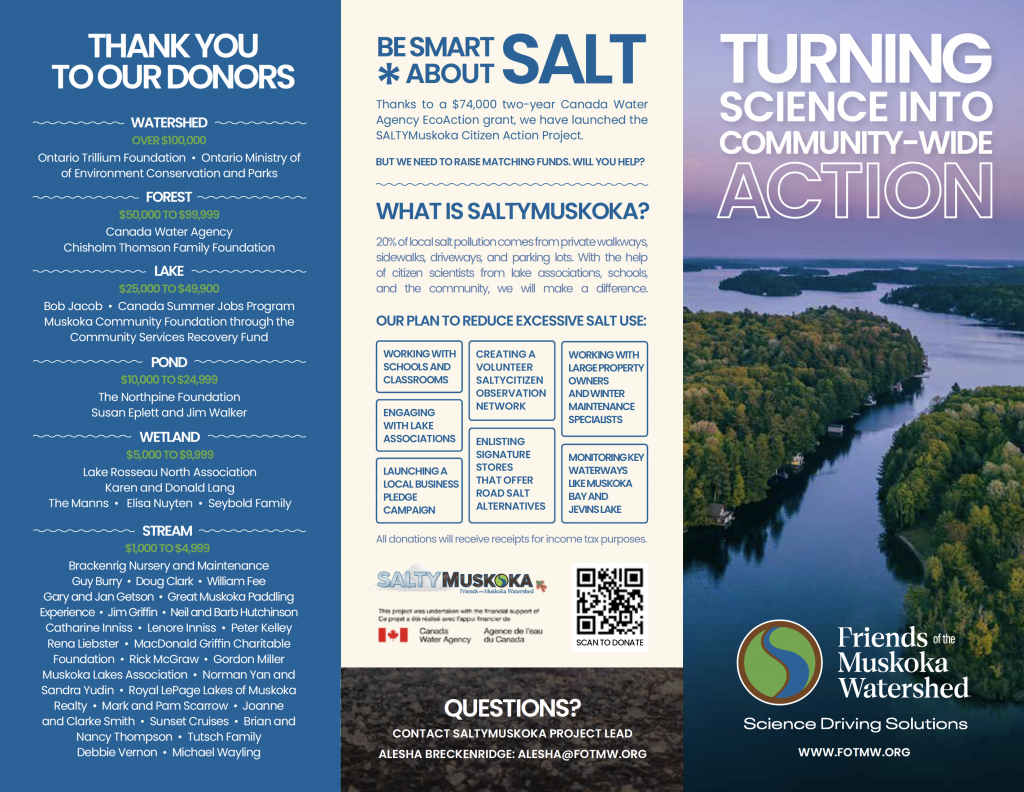
June 2025 AGM Highlights
Click either of the images on the right to view a downloadable PDF.
June 2026 AGM Highlights