
ASHMuskoka: Frequently “ashed” questions

Thank you to all the amazing volunteers and ash donors who contribute to the work of the Friends of the Muskoka Watershed and the betterment of our shared environment. Over 2,000 donations of home woodstove or fireplace ash have been made — a total contribution of over 30,000 kg of ash since 2019.
Below are the answers to some of the more frequently “ashed” questions about the program and the answers.
Learn more on our ASHMuskoka page.
What does Friends of the Muskoka Watershed do with donated wood ash?
Since 2019, FOTMW has researched the benefits of adding wood ash to our local forests. The first thing we did with the ash donations was to test the ash chemical composition. The laboratory studies indicate that Muskoka ash is 25-30% calcium plus smaller amounts of other key plant nutrients, including potassium, magnesium and phosphorus.
Working with three universities, we have applied over nine tonnes of processed wood ash to three sugar maple bushes and our research forest at Camp Big Canoe. Results have been very positive. We have seen that wood ash neutralizes the acidity of Muskoka soil which has been damaged by decades of acid rain. Preliminary research suggests that ash application to the soil increases tree vitality and growth, meaning that trees are more storm-resistant and have the potential to capture more carbon! We are also studying potential changes that may help mitigate spring flooding.
We worked with community volunteer scientists to expand our understanding of the benefits of residential wood ash. Donated, filtered, and mixed ash was distributed along with instructional kits to nearly 80 people across Muskoka. These community volunteer scientists monitor trees on their property for at least one year to assess improvements in overall health metrics, with a select number of participants sending us foliage and soil samples for chemical analysis at Trent University.
My buckets/pails are full, and I cannot attend the next ash drive. What should I do?
Because of the Provincial regulations that apply to residential wood ash, Friends of the Muskoka Watershed staff are not permitted to pick up or transport ash from private residences. Ash can only be accepted at the Rosewarne Transfer Station on Ash Drive days. However, we can provide you with an extra bucket or two for storage. Contact us at friends@fotmw.org.
📌 Our ASH Drives happen at the Bracebridge Transfer Station, 1065 Rosewarne Drive in Bracebridge. The 2026 dates so far are Jan. 17, Feb. 21, March 28 and April 19.
Can I spread wood ash on my own property?
We ask volunteers to provide us with wood ash for use in our research, but you may choose instead to sprinkle ash on your own property. Restoration is another important component of FOTMW’s work.
If I choose to spread my own ash, what do I need to know?
- Only use clean ash. Do not burn metallic foil, plastic products, pressure-treated wood, construction waste or wood that may contain chemical preservatives, insecticides, glue, nails, staples, other metals or paint.
- Allow your wood ash to cool completely – for several days before using. Hot ash is a real fire risk to homes, property and forests.
- Keep your ash dry until you are ready to spread it.
- Wear a mask, gloves and long clothing when spreading ash.
- Spread it in a location that you can keep people and pets away from for a couple of days.
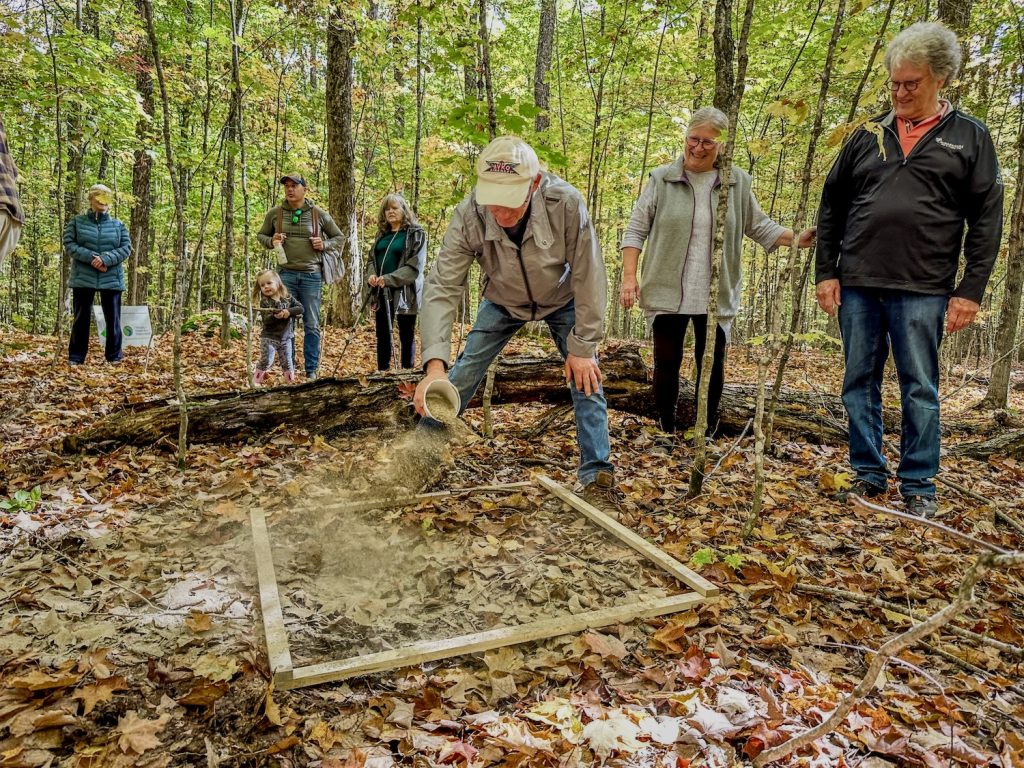
- Sprinkle the ash thinly, about one 750 gram plastic yogurt container over one square metre. (That is equivalent to 4 tonnes per hectare).
- Only apply ash to each location once. Research suggests that one application is enough to replace 50 years of calcium depletion caused by acid rain. (It is not an annual thing like fertilizer)
- Avoid spreading ash over the snow, on a steep slope, or near surface water.
How much wood ash do I need to make a difference?
We know the dosage—or prescription—of ash required to replace 50 years of acid rain damage. One 750 gram yogurt container of ash will restore the calcium lost in one square metre. (That’s the same as 4 tonnes per hectare.) One volunteer describes it as spreading ash like you are feeding chickens!
Do you care to know if I’m spreading ash to restore my own forest?
Yes, please! Contact us and let us know if you are a self-spreader by emailing us at friends@fotmw.org.
SALTYMuskoka: Frequently asked questions

The less road salt, the better!
Better for the environment, our equipment, vehicles and infrastructure, as well as your pocket book!
Below are some FAQs about road salt.
For more, visit our SALTYMuskoka page.
Why is road salt harmful?
- 25% of recreational lakes tested by the District of Muskoka have chloride levels above what is considered safe for sensitive aquatic life in our soft waters.
- It is not just lakes, rivers, and streams! Road salt damages drinking water, trees and plants, infrastructure, vehicles, clothing, pets, and buildings.
- We can make a difference at the source of pollution. Road salt enters our waterways from streets, sidewalks, driveways, and parking lots. You can take action and learn how to reduce your personal road salt use.
What are my alternatives to road salt?
- Tools first! Shovel more often. Use an ice chipper if necessary and use sand for traction.
- Wear proper winter footwear, invest in winter tires, and reduce driving speed.
- Redirect downspouts away from walkways and check that the melt path of your snow does not create icy, slipping hazards.
- Use sand instead of salt.
How can I minimize my use of road salt?

- Check the temperature first ~ road salt does not work when temperatures drop below -10°C.
- Use OUR GREEN CUP (or a small coffee mug) to reduce road salt: 12 ounces (350 ml) for an average driveway or 10 sidewalk squares. A little goes a long way!
- Email us at friends@fotmw.org for your own Green Cup.
- For smaller spaces, 1 tablespoon for 1 sidewalk square.
- Remember to give it time to work!
I am a winter maintenance professional or a facility owner/manager. Where can I learn more?
Learn about Smart About Salt Certification from Smart About Salt Council, or Landscape Ontario’s Academy of Snow & Ice Control (ASIC) training for winter maintenance professionals. Help save $ and use less road salt.